Monday, 11 November 2013

Nearsightedness

nearsightednessNearsightedness -- or myopia -- affects a significant number of people. But this eye disorder is easily corrected with eyeglasses, contact lenses, or surgery.
People with myopia or nearsightedness have difficulty seeing distant objects, but can clearly see objects that are near. For example, a person who is nearsighted may not be able to make out highway signs until they are just a few feet away.

What Causes Nearsightedness?
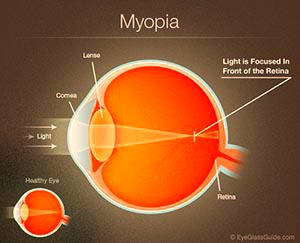
People who are nearsighted have what is called a refractive error. In nearsighted people, the eyeball is too long or the cornea has too much curvature, so the light entering the eye is not focused correctly. Images focus in front of the retina, the light-sensitive part of the eye, rather than directly on the retina, causing blurred vision.
Nearsightedness runs in families and usually appears in childhood. Usually the condition plateaus, but it can worsen with age.

What Are the Symptoms of Nearsightedness?
People who are nearsighted often complain of headaches, eyestrain, squinting, or fatigue when driving, playing sports, or looking more than a few feet away. Children commonly complain of not being able to see the board at school.

 How Is Nearsightedness Diagnosed?
Nearsightedness can be easily diagnosed using standard eye exams given by an eye doctor.
How Is Nearsightedness Treated?

Glasses, contact lenses, or refractive surgery can correct nearsightedness. With myopia, your prescription for glasses or contact lenses is a negative number, such as -3.00. The higher the number, the stronger your lenses will be. The prescription helps the eye focus light on the retina, clearing up the vision.

Read the original article on webmd.com

The only way to correct nearsightedness is to wear corrective glasses, contact lenses are surgery. It’s important to book an eye exam for your child if you’re worried as nearsightedness is linked to serious eye diseases such as glaucoma, macular degeneration and retina detachment.

Drop into 20/20 Eyeglass Superstore for all your eye care needs. We have a frame for every face and a price for any budget. We also have Independent Optometrists located on site who will be happy to examine your vision. Walk-in’s are welcome but we ask that you come 15 minutes prior to your desired appointment time.

Friday, 8 November 2013

Glaucoma Steals Sight without Warning

Glaucoma Steals Sight without WarningWhat is Glaucoma?
Glaucoma is a group of eye disorders that cause gradual damage to the optic nerve, a bundle of more than 1 million nerve fibers that send images from the eye to the brain. A healthy optic nerve is necessary for good vision.

The most common form of the disease, primary open angle glaucoma, is associated with increased eye pressure, which can slowly damage the optic nerve. This eye pressure results from excessive fluid build-up in the front of the eye. A clear liquid flows continuously in and out of a space called the anterior chamber to nourish nearby tissues. When the drainage system is not working properly, fluid cannot leave the eye. As it builds up, so does eye pressure.

Who Gets Glaucoma?
Glaucoma can affect anyone regardless of age or ethnic background. Three groups, however, are particularly at risk: those with a family history of glaucoma, African Americans over age 40 and everyone over age 60, especially Hispanics.

The number of Americans with glaucoma is growing because of several trends that have increased the sizes of the major risk groups:
  • Aging population: The Baby Boom generation is entering retirement age.
  • Growth of African American and Hispanic populations: Glaucoma is five times more common among African Americans and Hispanics than among Caucasians.
  • Ongoing obesity epidemic: Obesity accounts for the rising number of people with diabetes, who are twice as likely to develop glaucoma as those without diabetes.
What Are Symptoms of Glaucoma?
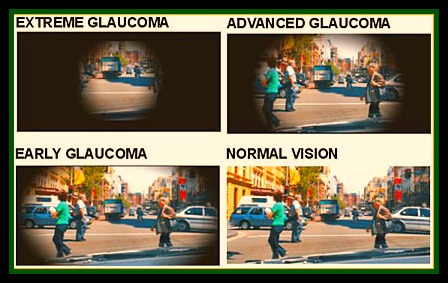
With primary open angle glaucoma, the most common type, damage to the optic nerve is so gradual that there are no symptoms at first. When symptoms do appear, it is usually loss of peripheral vision. You are able to see straight ahead, but miss objects to the side, as if you were looking through a tunnel. If glaucoma is left untreated, serious vision loss may occur in both eyes. Over time, straight-ahead vision may diminish until none remains.

A less common form of the disease is acute angle closure glaucoma. It occurs suddenly as the result of a rapid increase in eye pressure. Symptoms include severe eye pain, nausea, eye redness, seeing colored halos around lights and blurred vision. This condition is a medical emergency requiring immediate treatment, as blindness can occur in just one or two days. Treatment is either medication or surgery to allow fluid to drain out of the eye.


How Is Glaucoma Diagnosed? 
Glaucoma is diagnosed during a comprehensive eye exam. Your doctor will perform several different tests to look for eye problems and for changes in your eyes since your last exam:
  • Dilated eye exam. After drops are placed in your eyes to dilate (widen) them, a magnifying lens is used to examine your retina and optic nerve.
  • Visual acuity test. An eye chart test measures how well you see at various distances.
  • Visual field test. Measures your peripheral (side) vision.
  • Tonometry. Measures the pressure inside the eye.
  • Pachymetry. Measures the thickness of the cornea.
Read the original article on davisvision.com

If we feel that your eyes require further evaluation, we recommend that you schedule a full eye exam with our in-house optometrist. Please note there is a charge for this appointment.  You are free to schedule an appointment with another optometrist if you wish.

20/20 Eyeglass Superstore is a family operated business with three shops throughout central Florida.  Our number one goal is to become your reliable source for eye care, glasses and contacts.  Should you have any questions or comments, please feel free to contact us anytime.

Don’t forget to call ahead to make your appoint for your free vision screening in Orange City, Florida.  This promotion runs from December 15th – December 24th, 2012.
Orange City 20/20 Eyeglass Superstore
1270 Saxon Blvd,
Orange City, FL 32763
Tel: 386-774-5000

Thursday, 7 November 2013

Give Thanks For Great Eyesight

20/20 Eyeglass Superstore is Central Florida’s premier eyecare provider with three locations in Winter Park, Melbourne, and Orange City.  We are proud to feature thousands of frame styles, lenses from the leading manufacturers, and sunglasses from the brands you love and trust.

Every family owned 20/20 Eyeglass Superstore location features its own independent doctor of optometry as well as an in-house lab to ensure you receive your new customized glasses in as little as one hour.  Our technicians maintain the highest standards of technical skills with the latest in eyecare technology.
2020EyeGlass
Drop in at 20/20 Eyeglass Superstore we’re here to help you find a cheap eye exam in Orlando.  We offer all of our customers competitive prices, thousands of frames to choose from and superior customer service.  Our main goal is to become your trusted source for everything related to eye care. If you have any questions about where to find a cheap eye exam in Orlando, please make sure to contact us anytime. We look forward to hearing from you.

Wednesday, 6 November 2013

Corneal Blindness

Your vision is priceless and a thirty minute appointment once a year is certainly something you should be able to commit too. Getting your eyes tested regularly will help you stay on top of your general health, eye diseases and even headaches! Schedule an eye exam at 20/20 Eyeglass Superstore? You can schedule an eye exam online here, or call 407-767-5600

Corenal BlindnessOur eye care tips will help you prepare your eyes for the warmer season. Keep your eye drops in the fridge, preparing for allergies, and visiting your optometrist for an eye examination.
Here at 20/20 Eyeglass Superstore, we help thousands of Orlando, Melbourne City and Orange City residents purchase eyeglasses, contact lenses and sunglasses every day. We know purchasing new eyeglasses can be a challenge. Today we’re discussing frequently asked questions.

Tuesday, 5 November 2013

Low Vision Is a Visual Impairment

Low Vision Is a Visual ImpairmentLow vision is a visual impairment, not total vision blindness, which results in a permanent decrease in the acuity of an individual's vision field. Unlike normal vision impairments such as nearsightedness and farsightedness, low vision can't be fully corrected by using standard vision aids such as eyeglasses or contacts. According to the Association for the Blind and Visually Impaired (ABVI), an individual has low vision when "the better-seeing eye will not reach visual acuity of 20/70 or greater after the strongest correction aid is applied".
Common conditions that result in low vision include cataracts, stroke, glaucoma, macular degeneration, diabetic retinopathy and retinal detachment. The five most common types of low vision, as defined by the American Optometric Association/1, are as follows:
  • Loss of Central Vision
  • Loss of Peripheral (Side) Vision
  • Night Blindness
  • Blurred Vision
Early warning signs of low vision include difficulty recognizing objects up close or at a distance, differentiating between colors, and overall blurry vision. Individuals, through their primary eye care provider, should contact a Low Vision Eye Care Specialist who can perform a unique eye examination called a low vision evaluation.This type of examination involves a multitude of tests that assess the range of the vision field, ocular perception and sensitivity, assessment of any ocular injury or disease, and overall mobility of the eye. After this series of tests, the low vision specialist will perform tests with various telescopic and magnification aids to determine which low vision aid will provide the best visual field enhancement.

Read the original article on davisvision.com

20/20 Eyeglass Superstore is Central Florida’s premier eyecare provider with three locations in Winter Park, Melbourne, and Orange City.  We are proud to feature thousands of frame styles, lenses from the leading manufacturers, and sunglasses from the brands you love and trust.

Every family owned 20/20 Eyeglass Superstore location features its own independent doctor of optometry as well as an in-house lab to ensure you receive your new customized glasses in as little as one hour.  Our technicians maintain the highest standards of technical skills with the latest in eyecare technology.

Monday, 4 November 2013

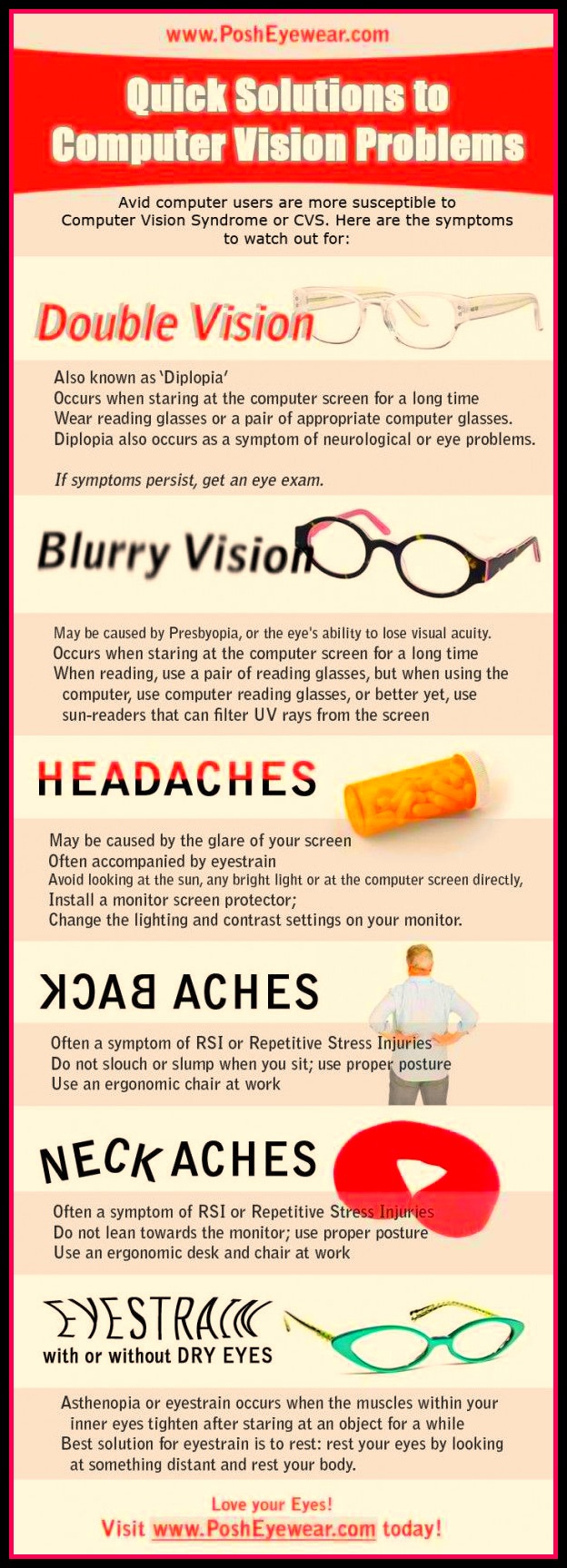
Computer Vision Syndrome

Do you suffer from regular headaches and wonder what the cause is? You should visit your optometrist! A large percentage of headaches are caused by visual problems and most general practitioners will recommend you get your eyes tested to see if that is the problem.

Routine eye exams also can also detect other underlying conditions.  Your optometrist will perform several tests during your eye exam that test and check your vision.  These tests are completely painless.  Some procedures are a bit uncomfortable but they aren’t hard to deal with.  A proper eye exam will take approximately one hour.
 
Computer Vision Problem
Visit your optometrist? Even if you don’t wear glasses and your eyes are feeling fine, we’re here to share several reasons why you should get your eyes tested on a regular basis.
Visiting your local optometrist allows doctors to look directly at your blood vessels which can reveal early warning signs of serious health problems such as hypertension, cardiovascular disease and diabetes before the symptoms show up anywhere else in the body.

If you haven’t had an eye exam in the last year, make sure you drop into one of our convenient locations to make an appointment or you can contact us online.  We look forward to seeing you soon!
Orange City 20/20 Eyeglass Superstore
1270 Saxon Blvd,
Orange City, FL 32763
Tel: 386-774-5000

Friday, 1 November 2013

UV light radiation can damage our eyes

UV light radiation can damage our eyesWe all know the value of guarding against sunburn and skin cancer by slathering on sunscreen, and most of us wear sunglasses in summer to shield our eyes from glare. When it comes to preserving eyesight over the long term, however, many of us have misconceptions about the sun’s dangers. Do you know the facts behind these myths?
  • Myth #1: Sunglasses are not necessary in winter.
    Fact: The damaging effects of UV rays are present during winter as well as summer. Sunglasses with UV protection are necessary whenever you spend time outdoors during daylight hours, all year round.
  • Myth #2: On overcast days, UV rays are not harmful.
    Fact: Just because the sun is not glaring brightly does not mean its UV rays are not affecting the eyes. If there’s daylight, UV rays are present. They penetrate through haze and clouds, and reflect off water, white sand, pavement and snow.
  • Myth #3: Our eyesight deteriorates with age simply because we get older.
    Fact: This is true to some extent, but the fact is that a lifetime of exposure to UV light increases the likelihood of developing macular degeneration, cataracts and other eye conditions. T
  • Myth #4: Adults’ eyes are at a higher risk of sun damage than children’s.
    Fact: Just the opposite is true. Children’s eyes are especially vulnerable to sun damage because they are still developing. Their pupils are larger, allowing in more light, and the lenses of their eyes are more transparent. They also spend more time outdoors than most adults. Brief but intense UV contact may cause corneal sunburn, the most immediate danger to children’s eyes from sun overexposure.
  • Myth #5: Only the sun emits ultraviolet light.
    Fact: Artificial light sources, such as tanning beds and welding machines, also produce UV radiation and require eye protection during use.
Remember: Shades, Hat, Veggies
Here are the best ways to protect your eyes:
  • When spending time outdoors, wear protective eyewear, such as polarized sunglasses, that blocks 99 to 100 percent of UV-A and UV-B rays.
  • Wear a wide-brimmed hat or cap, which will block about half of UV rays.
Children’s eyes are especially vulnerable to sun damage because they are still developing.
  • Remember that UV rays reflect off bright surfaces such as water, snow, white sand and pavement, making it critical—especially for children—to wear sunglasses and hats in the snow or at the beach, swimming pool or playground.
  • Always wear protective goggles when using a tanning bed or welding machine.
  • Eat a healthy diet. There is scientific evidence that a diet rich in brightly colored fruits and vegetables helps reduce the risk of sun damage to your eyes.
Many bright summer days are ahead. Enjoy outdoor activities safely by protecting your eyes—and those of your children—from the sun!

To read the original article click here

Our eye care tips will help you prepare your eyes for the warmer season. Keep your eye drops in the fridge, preparing for allergies, and visiting your optometrist for an eye examination.
If you’re on the market for new sunglasses, eyeglasses or contact lenses this Spring, check out our deals page for discounts and sales.